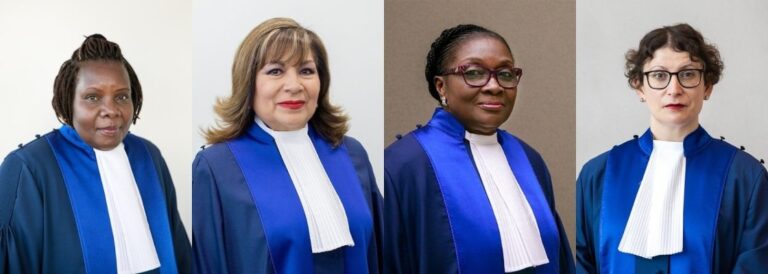
International Criminal Court
The International Criminal Court (ICC) is the world’s first permanent international court mandated to prosecute individuals for the gravest crimes of concern to humanity: genocide, crimes against humanity, war crimes, and the crime of aggression.
Created by the Rome Statute in 1998 and based in The Hague, the Netherlands, the ICC acts when national systems are unwilling or unable to investigate and prosecute. The Court operates independently from the United Nations, but cooperates closely with it and with regional and civil society partners.
The ICC prosecutes individuals rather than governments or organizations. Its foundation rests on the principle of complementarity — national courts have primary responsibility to prosecute serious crimes, and the ICC steps in only when they fail to act.
A key innovation of the Rome Statute was its explicit inclusion of gender-based crimes such as rape, sexual slavery, forced pregnancy, and enforced sterilization. This was the first time these acts were defined as among the most serious crimes under international law. These advances were achieved through sustained advocacy by the Women’s Caucus for Gender Justice — a global coalition of feminist legal advocates that laid the groundwork for the Women’s Initiatives for Gender Justice.
The ICC operates through four main organs:
- The Presidency, which provides overall judicial and administrative leadership.
- The Chambers, made up of 18 judges who conduct proceedings, issue rulings, and ensure fair trials.
- The Office of the Prosecutor (OTP), which investigates and prosecutes crimes.
- The Registry, which supports victims’ participation, witness protection, and outreach.
Since opening in 2002, the ICC has investigated situations in more than a dozen countries. It has contributed to advancing accountability for gender-based crimes, helping to establish that such acts can amount to war crimes, crimes against humanity, or acts of genocide.
Why the International Criminal Court Matters
Survivors of gender-based crimes, including sexual and reproductive violence, deserve recognition that the harm they suffered is not incidental — it is rooted in power and inequality. The ICC offers a space where their experiences can shape the record of truth and justice.
The Rome Statute and ICC jurisprudence embed gender-based crimes as central to the definition of atrocity crimes, setting a global standard for accountability.
Strengthening gender justice at the ICC advances a more inclusive and legitimate system of international law, one that confronts the structures that enable violence rather than only punishing its acts.
our work
Legal Research & Analysis
Women’s Initiatives for Gender Justice leads feminist legal analysis to strengthen the ICC’s understanding and prosecution of gender-based crimes, including sexual and reproductive violence.
We produce:
- Expert legal briefs and amicus submissions on gender based crimes, including forced pregnancy.
- Analyses of emerging ICC jurisprudence to ensure gender equality is embedded across cases.
- Practical guides translating complex legal developments for survivor-led and feminist organizations.
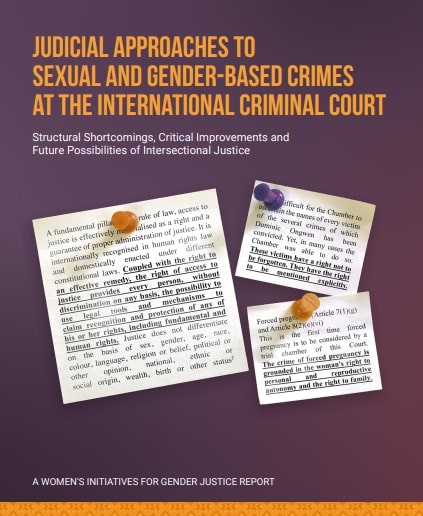
Judicial Approaches to Sexual and Gender-based Crimes at the International Criminal Court
Advocacy & campaigns
OUr advocacy at the International Criminal Court centres survivors’ agency and feminist perspectives in policy development and practice. Our work focuses on strengthening the Court’s approach to sexual and reproductive violence as gender-based crimes, and on ensuring that investigations, prosecutions, and reparations are informed by gender competence, trauma awareness, and intersectional analysis.
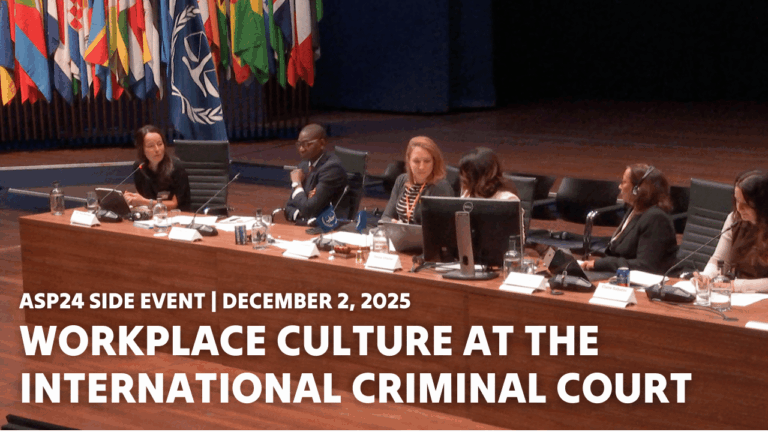
We engage with the Court to promote survivor-centred participation and reparations, while also supporting institutional reforms that strengthen the Court’s overall commitment to gender justice. This includes attention to leadership, accountability, and workplace culture, recognising that institutional practices shape how justice is delivered in practice.
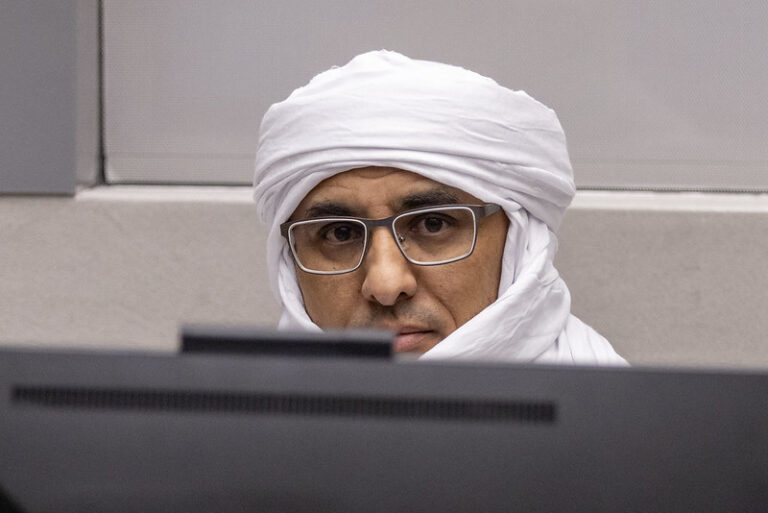
Recent engagements include advocacy on the Al Hassan reparations proceedings highlighting the need to recognise gendered and intersectional harm and analysis of gaps in the ICC’s framework for investigating allegations of prosecutorial misconduct.

Explainer: Investigation of Allegations of Misconduct by the ICC Prosecutor—Bridging the Gaps in the Court’s Regulatory Framework
Solidarity and Network-Building
We work at the intersection of civil society and the International Criminal Court, maintaining constructive working relationships with Court officials while staying grounded in feminist, survivor-informed advocacy. From this position, we help translate civil society expertise, concerns, and lived experience into spaces where policy and practice are shaped.
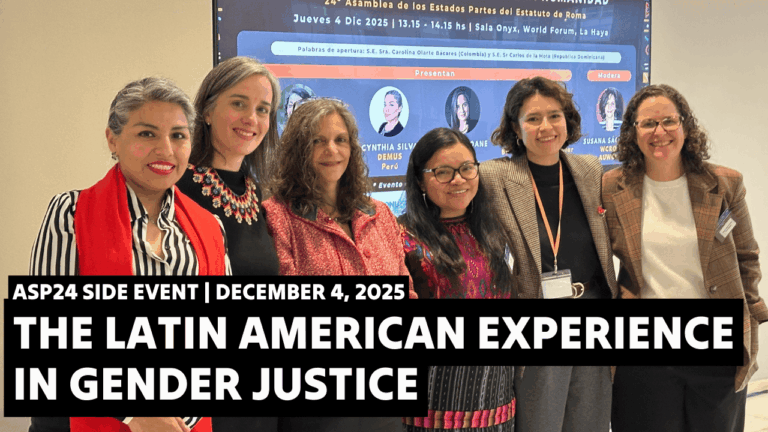
We rconvene and facilitate dialogue between gender justice advocates and ICC actors, including through side events at the Assembly of States Parties, participation in ICC–NGO roundtables, and informal exchanges around emerging legal and institutional issues. These spaces enable civil society perspectives on gender justice to inform discussions on investigations, prosecutions, reparations, and institutional reform.
Alongside this engagement with the Court, we collaborate with survivor-led groups, feminist legal networks, and international partners to ensure that advocacy remains accountable, intersectional, and connected to broader movements for justice. We help ensure that diverse expertise and perspectives can meaningfully reach the Court and shape how gender justice is understood and pursued in practice.
IMPACT
We contributed to the integration of gender justice within the ICC Office of the Prosecutor’s policies, including frameworks on gender-based crimes and gender persecution, supporting more consistent and informed approaches to investigation and prosecution.
We’ve supported the development of ICC jurisprudence on gender-based and reproductive violence through feminist legal submissions, including amicus briefs in landmark cases such as Ongwen, strengthening how these harms are recognised and addressed in law.
We’ve engaged in advocacy and coalition efforts that informed the ICC’s Strategy on Gender Equality and Workplace Culture and related reforms, while supporting more meaningful survivor participation and visibility in proceedings and reparations processes.