
ASP 24 | Workplace Culture at the International Criminal Court
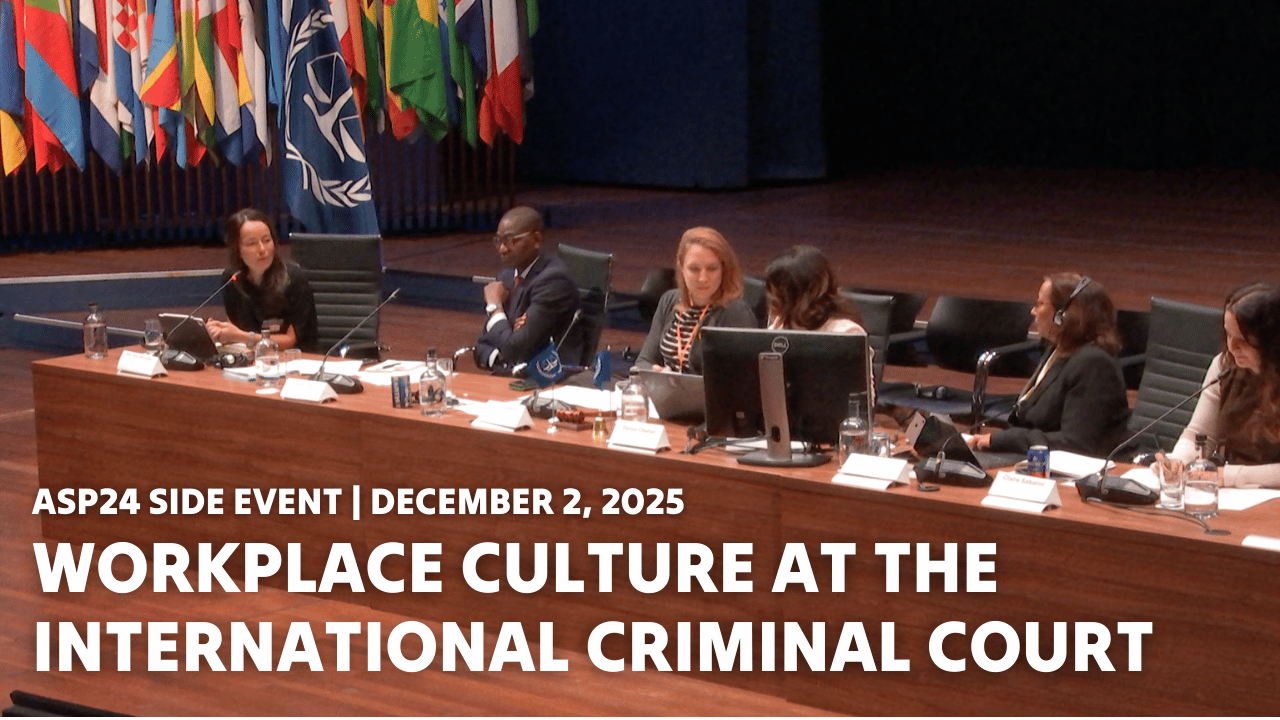
3 December 2025 — Yesterday at the 24th Assembly of States Parties of the International Criminal Court, Women’s Initiatives for Gender Justice and the International Federation for Human Rights (FIDH) with the support of Australia, Austria, Canada, Czechia, South Africa, Sweden, Switzerland, and the United Kingdom convened over 160 participants in person and online for a frank examination of workplace culture at the International Criminal Court (ICC).
Participants identified concrete steps needed to build trust, strengthen transparency, and embed feminist, inclusive leadership across the Court.
“Avoiding this conversation will not protect the Court”
Opening the event, Alix Vuillemin (Women’s Initiatives for Gender Justice) stressed that workplace integrity is central to the Court’s legitimacy.
“The ICC’s legal authority comes from the Rome Statute. Its moral authority comes from organisational integrity,” she stated. “Avoiding this conversation will not protect the Court.”
She noted that a resilient internal culture is critical “at a time where the Court is under tremendous external pressure.”
Sharp rise in misconduct reports signals systemic concerns
Silvain Sana, Head of the ICC’s Independent Oversight Mechanism (IOM), reported a more than 75 percent increase in misconduct reports this year, describing the trend as “evidence of systemic problems that have not been resolved.” Investigators are managing an average of 20–30 cases each, a workload he called “untenable” in light of the IOM’s too modest budget and capacity.
He also outlined new developments in accountability for elected officials, including the establishment of advisory panels and the operationalisation of a permanent due diligence process.
Experts identify entrenched hierarchies and opacity as key drivers of harm
Dr Purna Sen, former special adviser to the ICC Prosecutor on workplace culture, drew attention to structural power imbalances. “Anybody who has power has the potential to abuse it,” she said. She emphasised the need to name misconduct clearly—“We have to say this is sexual harassment; we have to say this is assault”—and called for systems “worthy of the confidence of those who use them.”
Claire Sabatini, the ICC’s Office of the Prosecutor (OTP) Gender Focal Point, warned that despite a comprehensive policy framework, implementation remains inconsistent. “Policies alone cannot change culture,” she stated. “If patriarchal norms continue to shape interactions, commitments on paper do not translate into practice.” She called for more direct communication with staff and an end to opacity in decision-making.
Kim Thuy Seelinger, former special adviser to the ICC Prosecutor on sexual violence in conflict, stressed that accountability requires nuance. “People need to be trusted and resourced to do their job, have autonomy in decision-making, and receive recognition for their work. These practices are possible even within a steep hierarchy.”
She highlighted evidence-based leadership practices, including looking further afield for best practices from other industries, and called for open communication, recognition of good management, and tailored, context-specific training that reflects the lived reality of the institution and resonates with the staff.
States Parties emphasise the need for transparency and accountability
Representatives from Australia and Austria reiterated their commitment to supporting improvements at the Court. Australian Ambassador Greg French emphasised that bridging gaps between policy and practice “is vital to maintain trust and support stronger accountability.” Austria called for clear expectations, meaningful consequences for misconduct, and protection measures for those who report.
Key steps forward identified
As discussions turned toward implementation, speakers emphasised that the challenges identified are neither novel nor insurmountable, highlighting a need for consistent follow-through, institutional courage, and transparency in applying existing tools.
As Danya Chaikel (FIDH) indicates: “The good news is that solutions exist. There are concrete steps that can be taken, and some have already begun. But they must be implemented consistently and transparently, and applied to both staff and elected officials.”
Across interventions, participants outlined priority actions, including to:
- Seriously evaluate the Court’s workplace culture framework, including independent assessments of specific offices or policies.
- Create a confidential, trusted complaint mechanism for misconduct by elected officials, with clear communication around procedure and safeguards.
- Strengthen transparent, timely communication from ICC leadership to address opacity and rebuild trust.
- Embed approaches sensitive to complainants and victims into all internal reporting and support systems.
- Address structural hierarchies through intentional feminist leadership practices and shared decision-making.
- Ensure accountability for elected officials via operationalised due diligence mechanisms and advisory panels.
- Resource the IOM adequately to meet current caseloads and reduce harm caused by delays.
- Recognise and replicate healthy team cultures already functioning within the institution.
- Ensure meaningful reform in election and vetting practices, to ensure that only candidates with demonstrable integrity, management skills, and ethical leadership enter senior positions.
The ICC’s Staff Union Council closed the event with a comment for continuous engagement. “We need constant monitoring and a dedicated facilitation mechanism for workplace culture,” representatives stated, welcoming ongoing discussions on strengthening the ICC’s ethics function.
WIGJ’s ongoing commitment
Women’s Initiatives for Gender Justice, together with partners including FIDH, will continue to monitor developments, support efforts to improve workplace integrity, and advocate for systemic reforms that align with feminist, intersectional, and survivor-centred principles.
Find a full recording of the event here.