
Solidarity in Facing Attacks on Gender Justice | Gender Justice in International Criminal Law Conference 2025
-
Gender justice is facing coordinated political, financial, and ideological attacks, with funding cuts acting as a central pressure point, but gender mainstreaming within institutions is a critical source of resilience against rollback.
-
Examples of attacks on gender justice include gender persecution in Afghanistan and growing anti-LBGTQI+ narratives, jeopardizing implementation of broader gender justice frameworks.
-
We must move beyond rhetorical promises of solidarity to form durable networks, survivor-led justice strategies, and long-term institutional positioning.
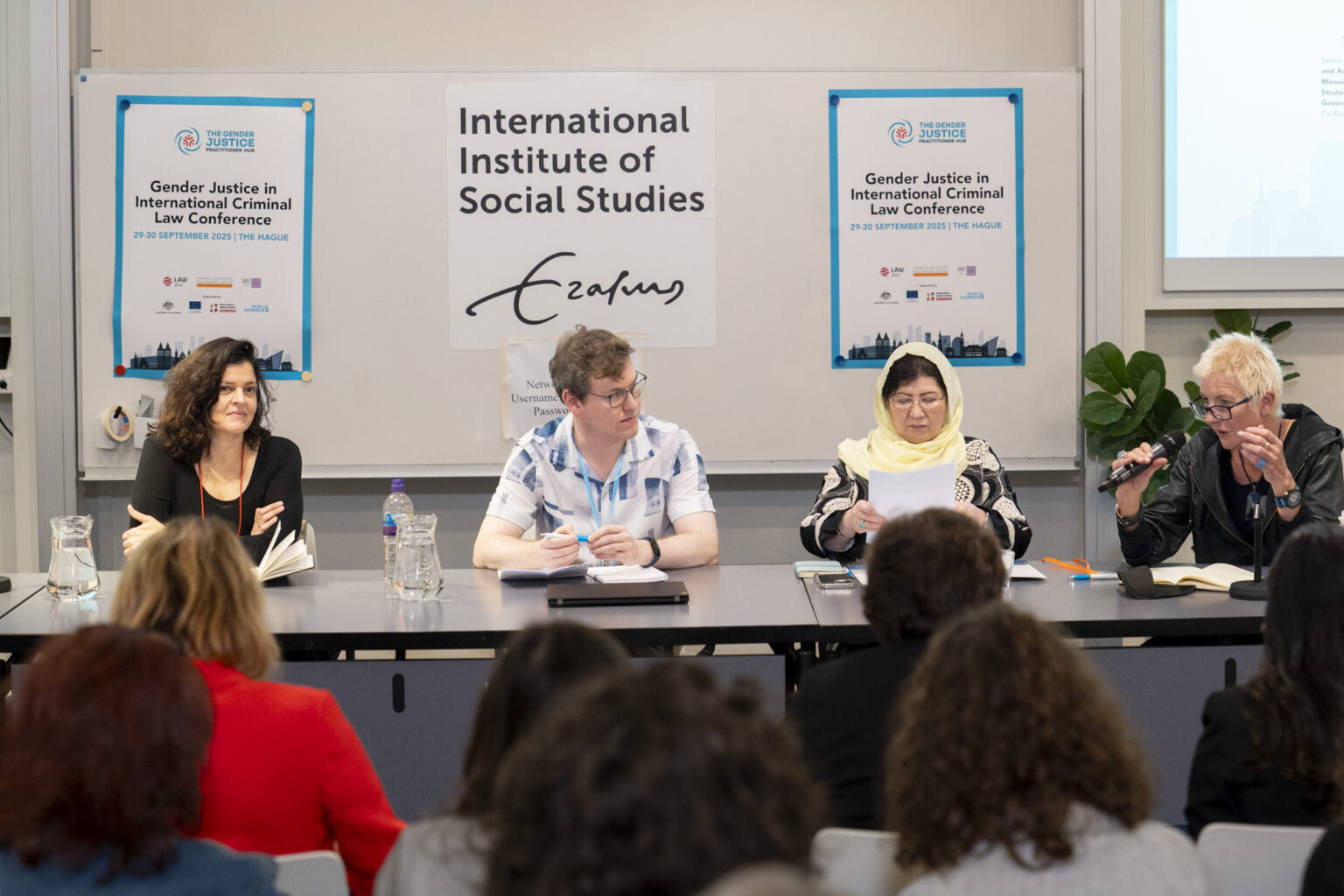
The Hague, September 29, 2025 — This panel examined the accelerating backlash against gender justice in international criminal law (ICL) and the implications for solidarity, strategy, and institutional resilience. Moderated by British lawyer and former Secretary General Women’s International League for Peace and Freedom Madeleine Rees, the discussion framed the current moment as a structural rupture exposing the fragility of funding models, institutional commitments, and coalition-building practices that had underpinned recent progress.
Drawing on global practitioner consultations, international legal expert Sareta Ashraph, reported overwhelming agreement that gender justice is under sustained attack. Participants identified funding cuts as a central tool of backlash, with immediate consequences including staff losses, programme closures, and erosion of survivor trust. Ashraph emphasized that the impact extends beyond resources to institutional behavior, including early or over-compliance, shrinking space for gender analysis, and a renewed elevation of so-called gender-blind approaches. She noted that organizations with deeply embedded gender mainstreaming have been more resistant to rollback.
Deputy Director of the Afghanistan Organization for Development of Human Right (AODHR) Momina Yari grounded these dynamics in the context of Afghanistan, describing the Taliban’s systematic exclusion of women and girls from public life as gender persecution potentially amounting to crimes against humanity. She emphasized that Afghan women continue to resist through documentation and advocacy, despite severe risk, and stressed that solidarity must translate into concrete support for accountability mechanisms and Afghan-led civil society.
Addressing sexual orientation and gender identity, Legal Action Worldwide (LAW) Programme Manager Jack Torbet highlighted how anti-LGBTQI+ narratives are being deliberately instrumentalized to fracture solidarity and undermine gender justice more broadly. While acknowledging limited legal gains, including at the ICC, he warned that funding retrenchment and institutional caution risk reversing progress and weakening future accountability efforts. The panel concluded that solidarity must move beyond rhetoric toward long-term, strategic cooperation grounded in intersectionality, survivor leadership, and power-aware coalition-building.
“Law is an architecture. If we don’t get that architecture right, we are left hanging onto law alone.”- Madeleine Rees


