
Upgrading and Applying Gender Justice Toolkits in ICL | Gender Justice In International Criminal Law Conference 2025
-
Gender justice toolkits can meaningfully improve investigations, prosecutions, and judicial reasoning when applied early, consistently, and across all crimes, not only sexual violence. Survivor-centred, intersectional, and context-specific approaches are essential to prevent toolkits from becoming abstract or extractive.
-
Practical guides and checklists developed with survivors and local actors can bridge gaps between global norms and local realities.
-
Toolkits can drive institutional change, but only if paired with adequate resources, political commitment, and shared responsibility across teams. There are growing risks of over-documentation, instrumentalization, and selective application of gender frameworks, requiring ongoing critical reflection.
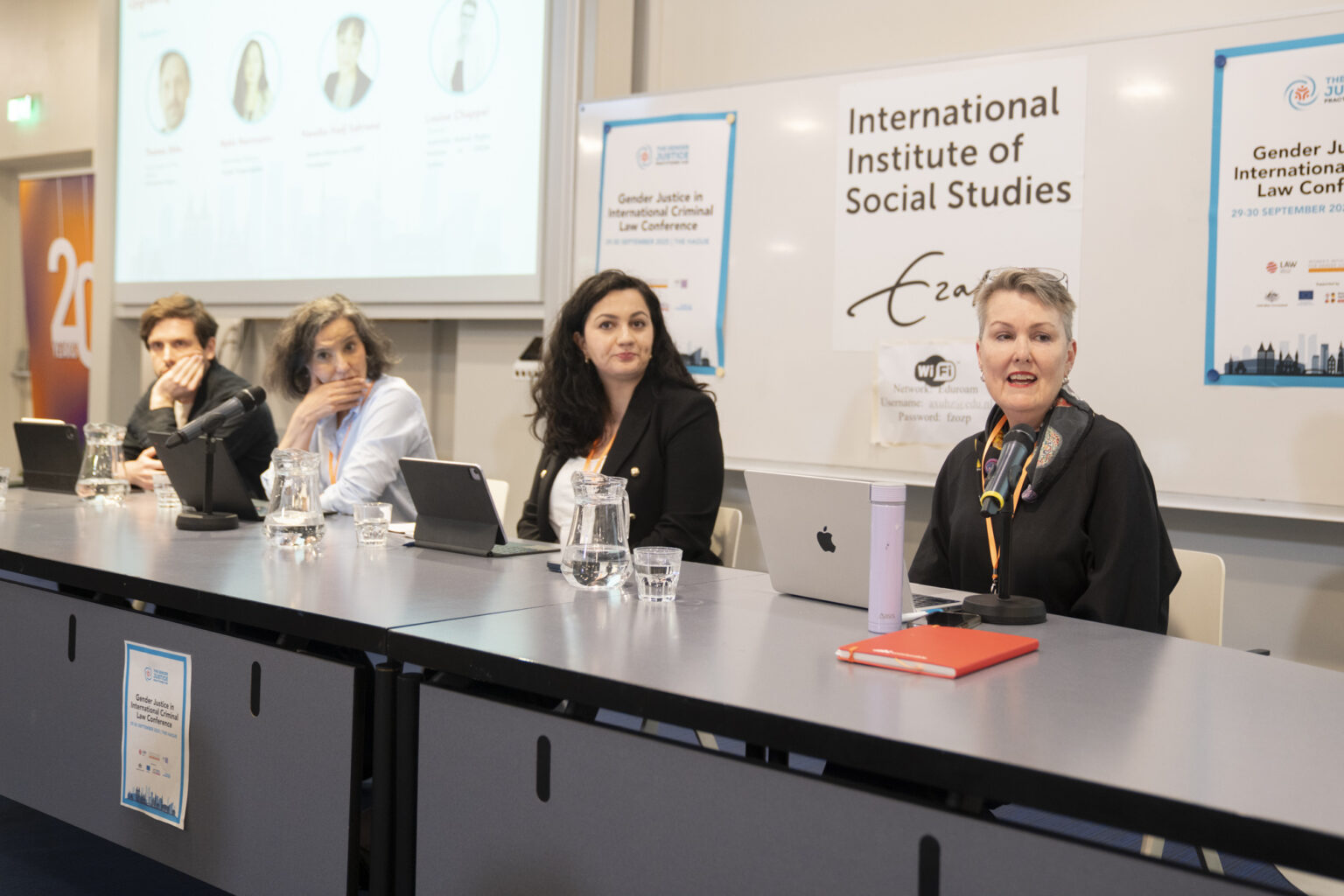
The Hague, September 29, 2025 – This panel examined how gender justice toolkits are being updated, applied, and contested in practice, with a focus on translating feminist and intersectional principles into operational accountability work. The discussion emphasized that tools alone are insufficient unless embedded in institutional culture, survivor leadership, and contextual knowledge.
Louise Chappell, Director of the Australian Human Rights Institute at UNSW Sydney, introduced efforts to translate feminist legal analysis into practical guidance for judges, drawing on the Feminist Judgments: Reimagining the International Criminal Court project. She argued that applying a gender lens does not require legal innovation beyond the Rome Statute, but rather a shift in perspective that makes invisible harms visible and strengthens the legitimacy of international courts.
Natia Navrouzov, Executive Director of Yazda, highlighted survivor-led documentation and context-specific guidance developed by Yazda in response to ISIS crimes against the Yazidi community. She demonstrated how culturally grounded tools—such as interview guides co-created with survivors—can prevent re-traumatization, improve evidentiary accuracy, and address power imbalances between investigators and affected communities.
Hassiba Hadj Sahraoui, gender advisor and SGBV investigator, reflected on efforts within UN investigative mechanisms to systematize gender analysis across fact-finding missions and commissions of inquiry. She underscored that gender analysis must be treated as a shared institutional responsibility, not delegated solely to gender advisors, and warned that chronic underfunding severely constrains meaningful implementation.
Thomas Ebbs, Senior Legal and Policy Advisor at All Survivors Project, offered a critical assessment of gender justice toolkits from the perspective of male and LGBTQI+ survivors of conflict-related sexual violence. While acknowledging progress in visibility and recognition, he cautioned against superficial or selective applications that reproduce hierarchies of harm, marginalize certain survivors, and prioritize institutional convenience over survivor-defined justice. The panel concluded that gender justice toolkits are most effective when treated as living frameworks co-designed with survivors, adapted to context, and continuously interrogated for ethical, political, and practical limits.
“There are no excuses left. The law already allows judges to do this.” — Louise Chappell


