
Gender Justice Across the MENA REgion | Gender Justice In International Criminal Law Conference 2025
-
Gender justice in the MENA region is driven by feminist, survivor-led, and community-based work that is often overlooked in global gender and justice debates. Gendered harms in contexts of occupation, authoritarianism, and conflict are deeply shaped by intersecting systems of patriarchy, colonialism, class, displacement, and stigma.
-
Regional fragmentation and restrictions on movement deliberately undermine cross-border feminist solidarity and shared learning. Meaningful gender justice requires locally rooted language, strategies, and accountability pathways, rather than reliance on international frameworks alone.
-
The Women, Peace and Security (WPS) agenda is unevenly engaged with across the region, viewed by many as externally imposed, securitized, or insufficiently responsive to lived realities.
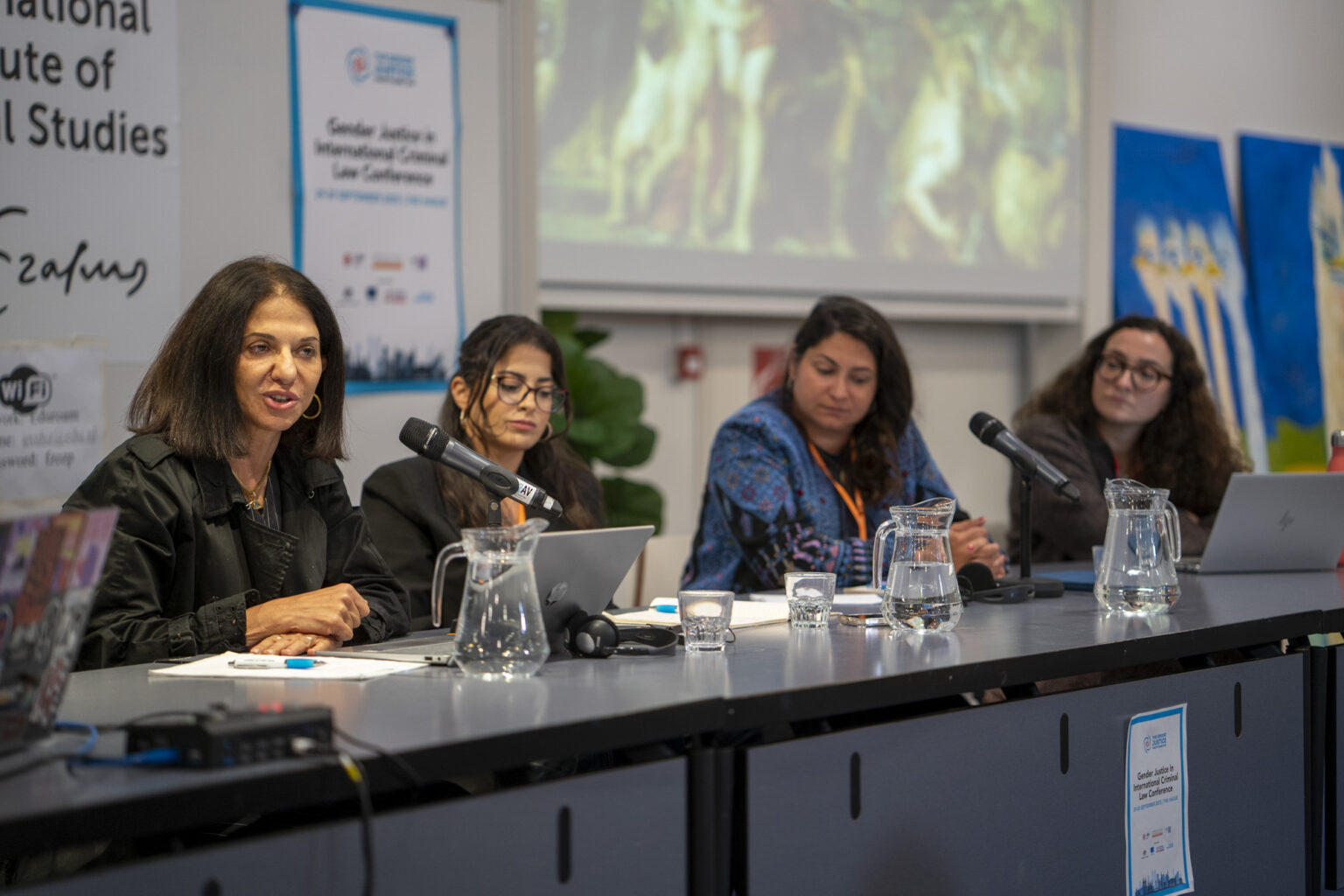
The Hague, September 30, 2025 – This workshop-style panel explored how gender justice is understood, practiced, and contested across the Middle East and North Africa, centring regional feminist leadership and lived experience.
Moderated by Razan Rashidi, Executive Director of the Syria Campaign, the session prioritized dialogue and collective reflection over formal presentations. Bilge Sahin, Assistant Professor in Conflict and Peace Studies at the ISS, examined how women’s organizations across the MENA region engage selectively, and sometimes reject, the Women, Peace and Security agenda. Drawing on comparative research, she highlighted how many groups find WPS overly militarized, externally imposed, or disconnected from socioeconomic realities, while others strategically reinterpret it to advance locally defined priorities. Sahin emphasized that gender justice in the region is plural, evolving, and rooted in everyday experiences rather than fixed frameworks.
Rima Fawaz El Husseini grounded the discussion in Lebanon, illustrating how sectarian personal status laws, patriarchal legal structures, and post-conflict silencing continue to shape women’s access to justice. She emphasized that gender justice is not only about legal equality but about dignity, safety, and transforming narratives that confine women to victimhood. Drawing on grassroots work in Baalbek, she highlighted how reproductive health, legal aid, and community spaces can function as entry points for feminist solidarity and agency.
Kifayeh Kharim, International Advocacy Officer at Women’s Centre for Legal Aid and Counselling, addressed Palestine, detailing how occupation, detention, sexual violence, and stigma intersect to silence women and girls. She described systematic sexualized humiliation at checkpoints and in detention, barriers to reporting, and the exploitation of cultural norms by Israeli forces. Kharim underscored why many Palestinian feminists distrust the WPS agenda and international mechanisms, instead turning to people-led strategies such as documentation, boycott, and transnational solidarity. Across the discussion, participants stressed that gender justice in the MENA region cannot be advanced without confronting power, colonial violence, and fragmentation, and without amplifying regional feminist leadership as central to global justice efforts.
“Sexual violence is used precisely because it will not be reported.” — Kifayeh Kharim


