
Gender Justice in Palestine | Gender Justice In International Criminal Law Conference 2025
-
The gendered impacts of occupation, siege, and mass violence in Palestine have long been marginalized within international criminal law and gender justice spaces, despite decades of documentation by Palestinian feminists. Palestinian women experience intersecting harms arising from occupation, displacement, detention, sexual violence, and patriarchal structures that reinforce one another.
-
Sexual and gender-based violence in detention and during military operations takes multiple forms, often obscured by narrow legal definitions and cultural stigma.
-
Accountability efforts face systematic obstruction, including sanctions, criminalization of engagement with international mechanisms, and severe restrictions on documentation. Meaningful solidarity requires centring Palestinian feminist leadership, resisting gender-blind approaches, and confronting political and institutional barriers to action.
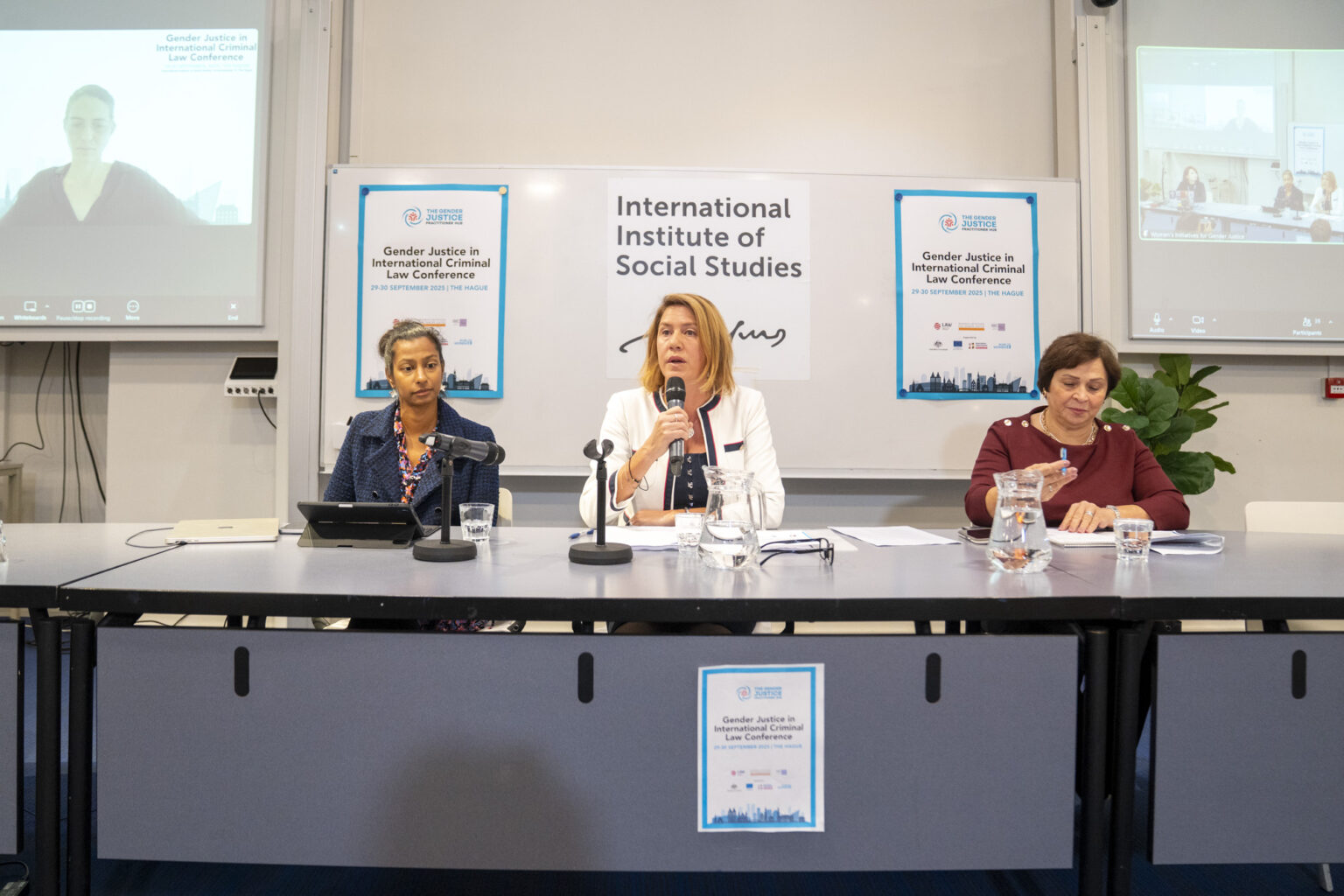
The Hague, September 30, 2025 – This panel addressed the urgent need to centre gender justice in accountability efforts relating to Palestine, situating current violations within the long-standing structures of occupation, settler colonialism, and apartheid. Moderated by Antonia Mulvey, Founder and Executive Director of Legal Action Worldwide, the discussion opened with a recognition that the gender and ICL community has historically failed to adequately engage with Palestine, a gap that remains consequential amid ongoing mass violence.
Randa Siniora, Deputy Director General of Women’s Center for Legal Aid and Counselling, described how Palestinian women face compounded harms arising from occupation policies and patriarchal systems that mutually reinforce one another. Drawing on decades of work by the Women’s Center for Legal Aid and Counseling, she detailed gendered violations including sexual violence in detention, reproductive violence, family separation, and coercive dependency created by residency and permit regimes. Siniora emphasized the extreme risks faced by Palestinian human rights defenders, including sanctions, criminalization, and surveillance, and highlighted the difficulty of documenting sexual violence under conditions of fear, stigma, and repression.
Yuli Novak, Executive Director of B’Tselem, situated abuses in Israeli detention facilities within a broader system of dehumanization, describing a shift toward what she characterized as systematic torture practices following October 2023. She underscored that detention, arbitrary violence, and humiliation are not isolated acts but part of a wider regime that erases individual identity and collective humanity.
Amrita Kapur, Secretary-General of Women’s International League for Peace and Freedom, framed Palestinian feminist resistance as both legal and political, highlighting survivor-led documentation, everyday acts of survival, and transnational feminist solidarity as critical forms of resistance. She stressed that accountability must address not only individual criminal responsibility but also the structural drivers of violence, including militarism, patriarchy, and colonial domination.
The panel concluded with a call to action for practitioners to speak out, challenge gender-blind narratives, support Palestinian and Israeli human rights defenders, and use all available legal and political tools to prevent further harm.
“Women’s bodies are used as tools of humiliation and war under occupation.” — Randa Siniora


