
Next Generation Strategies in ICL | Gender Justice In International Criminal Law Conference 2025
-
International criminal law must move beyond reactive crisis management toward anticipatory, future-oriented strategies that address emerging harms and systemic gaps.
-
Three key areas offer significant opportunities for strategisation:
- The draft Crimes Against Humanity (CAH) treaty offers a critical opportunity to strengthen gender competence, prevention, and interstate accountability if negotiations are approached ambitiously.
- Enumerating the slave trade and slavery crimes would correct longstanding legal gaps and strengthen accountability for deeply gendered forms of exploitation.
- Integrating health and social sciences can significantly enhance understanding, investigation, and adjudication of gender-based crimes and their long-term impacts.
-
Feminist approaches to technology and artificial intelligence are essential to ensure that digital tools support accountability without reproducing harm, bias, or exclusion.
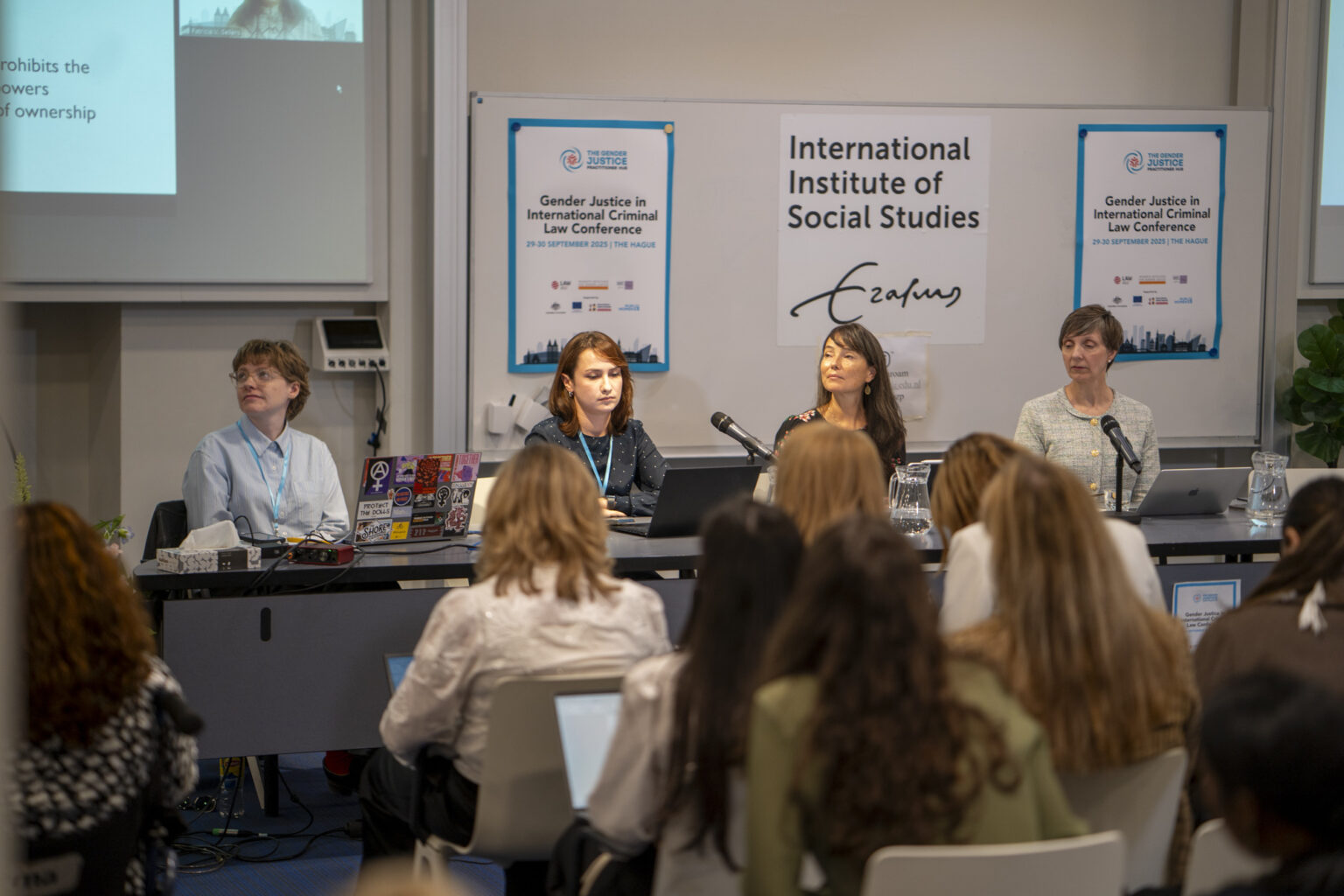
The Hague, September 30, 2025 – This final panel explored next-generation strategies for strengthening gender justice in international criminal law (ICL), emphasizing the need to reimagine legal tools, evidentiary practices, and institutional approaches in response to evolving forms of violence and accountability. Moderated by Valeria Babără, Legal and Advocacy Advisor at Women’s Initiatives for Gender Justice, the session situated forward-looking strategy within a context of geopolitical instability, funding constraints, and technological transformation.
Leila Sadat, James Carr Professor of International Criminal Law at Washington University School of Law, framed the draft Crimes Against Humanity treaty as a pivotal opportunity to advance gender competence across prevention, prosecution, and interstate responsibility. She cautioned against “negotiating against ourselves” and urged civil society and states to advocate ambitious language on gender, modes of liability, and emerging crimes, noting that crimes against humanity increasingly sit at the core of contemporary accountability efforts.
International criminal lawyer Patricia Viseur Sellers focused on proposals to enumerate the slave trade and slavery crimes in both the CAH treaty and the Rome Statute, identifying these omissions as persistent impunity gaps. She emphasized that slavery and the slave trade are inherently gendered crimes, deeply embedded in patterns of sexual violence, forced marriage, child soldiering, and reproductive exploitation, and argued that naming these harms is essential for justice, reparations, and historical truth.
Kim Thuy Seelinger, Professor at the Washington University School of Public Health, highlighted the untapped potential of health and social sciences to strengthen gender-based crime investigations, legal narratives, and reparations. She demonstrated how medical and public health evidence can illuminate the full scope and long-term impacts of crimes such as starvation, reproductive violence, and detention-related abuse, and called for structured mechanisms to translate interdisciplinary knowledge into legal practice.
Valerie Oosterveld, Professor & Western Research Chair in International Criminal Justice, Faculty of Law at Western University addressed feminist approaches to technology and artificial intelligence, outlining both the growing reliance on digital tools in investigations and the risks they pose to survivors and accountability. She emphasized the need for survivor-centred design, standardized safeguards, and long-term evidence preservation, while also drawing attention to the increasing use of technology to perpetrate sexual and gender-based crimes.
The panel concluded with a shared call to build an international criminal justice ecosystem that is adaptive, interdisciplinary, and grounded in feminist foresight rather than institutional inertia.
“If we don’t understand harm, we can’t explain it, prove it, or repair it.” — Kim Thuy Seelinger


